
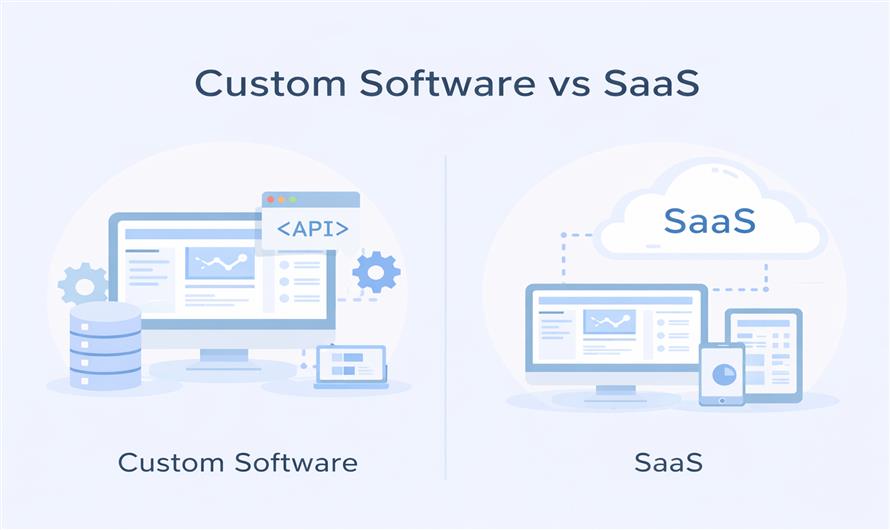
As enterprises scale, technology decisions become less about speed and more about long-term impact. One of the most common questions organizations face is whether to rely on Software-as-a-Service (SaaS) platforms or invest incustom software solutions. While SaaS products offer convenience and rapid deployment, they often introduce limitations as systems grow more complex. Custom software, on the other hand, provides flexibility and control but requires a more deliberate investment.
Choosing between SaaS and custom software is not about which option is “better,” but which approach aligns with an organization’s growth strategy, operational complexity, and integration needs.
Understanding SaaS Platforms
SaaS platforms are pre-built applications delivered over the internet and maintained by third-party vendors. They are designed to address common business needs such as customer management, content publishing, analytics, or workflow automation.
Key Benefits of SaaS
Fast deployment with minimal setup
Lower upfront costs
Vendor-managed maintenance and updates
Predictable subscription pricing
For early-stage companies or teams with standardized requirements, SaaS can be a practical and efficient choice.
Where SaaS Works Well
SaaS platforms are well suited for organizations that:
Have simple or standardized workflows
Require minimal customization
Can adapt processes to match the platform
Do not rely heavily on complex integrations
In these cases, SaaS helps teams move quickly without the overhead of building and maintaining custom systems.
The Limitations of SaaS at Enterprise Scale
As organizations grow, SaaS platforms often begin to show constraints. Enterprises typically operate across multiple systems, departments, and data sources, which creates challenges that off-the-shelf platforms are not designed to handle.
Common SaaS limitations include:
Restricted customization options
Fixed data models and workflows
Limited control over integrations
Performance issues at scale
Dependency on vendor roadmaps
These limitations can slow innovation and force organizations to adopt workarounds that increase technical debt.
What Are Custom Software Solutions?
Custom software solutions are purpose-built applications designed specifically for an organization’s requirements. Instead of adapting processes to fit a product, custom software is designed to support existing workflows, integrations, and long-term objectives.
Custom solutions can include:
Web applications tailored to internal processes
Custom CMS platforms for complex content needs
API-driven systems connecting multiple platforms
Enterprise integration layers extending existing systems
This approach prioritizes alignment with business needs rather than convenience.
Why Enterprises Choose Custom Software
For growing organizations, flexibility and control become critical. Custom software solutions allow enterprises to design systems around their operations instead of reshaping operations to fit a tool.
Key Advantages of Custom Software
Full control over features and functionality
Scalable architecture built for growth
Seamless integration with existing systems
Improved performance for high-volume usage
Ownership of data and platform direction
Custom software becomes a strategic asset rather than a dependency.
Integration: The Deciding Factor
Integration is often the tipping point between SaaS and custom solutions. Enterprises rarely operate in isolation; they rely on CRMs, ERPs, analytics tools, loyalty systems, and third-party platforms.
SaaS platforms typically offer:
Pre-built integrations with popular tools
Limited flexibility beyond supported APIs
Custom software allows:
Tailored API integrations
Data transformation between incompatible systems
Centralized control over data flow
When integrations drive business value, custom software offers a clear advantage.
Scalability Beyond User Count
Scalability is not just about adding users—it’s about handling:
Increased data volume
Complex workflows
Multiple integrations
Performance under peak loads
SaaS platforms are optimized for general use cases, which can become a bottleneck for enterprises with unique scaling requirements. Custom software is designed with these demands in mind from the outset.
Cost Considerations: Short-Term vs Long-Term
SaaS platforms often appear more cost-effective initially due to lower upfront investment. However, long-term costs can increase as organizations:
Add users or features
Require premium plans
Pay for multiple overlapping tools
Custom software requires higher upfront investment but can reduce long-term costs by:
Eliminating redundant subscriptions
Consolidating systems
Reducing inefficiencies
For enterprises, total cost of ownership is often more important than initial spend.
Security and Compliance
Enterprises operating in regulated environments must meet strict security and compliance requirements. SaaS platforms may not always provide the level of control needed to address industry-specific standards.
Custom software solutions enable:
Fine-grained access control
Custom authentication mechanisms
Data residency compliance
Detailed auditing and monitoring
This level of control is essential for organizations handling sensitive data.
When SaaS Is the Right Choice
Despite its limitations, SaaS remains a strong option when:
Speed of deployment is critical
Requirements are well-defined and unlikely to change
Integrations are minimal
Budget constraints outweigh long-term flexibility
SaaS can also complement custom software when used strategically.
When Custom Software Is the Better Fit
Custom software solutions are ideal when:
Workflows are complex or unique
Integrations are central to operations
Scalability requirements go beyond standard use cases
Long-term flexibility and control are priorities
For enterprises planning sustained growth, custom software provides a foundation that evolves with the business.
Hybrid Approaches: Combining SaaS and Custom Software
Many enterprises adopt a hybrid approach, using SaaS platforms where they make sense and extending them with custom software.
Examples include:
Custom integration layers connecting SaaS tools
Custom CMS platforms feeding SaaS analytics tools
Custom workflows built around SaaS CRMs
This approach balances speed with flexibility.
Making the Right Decision for Enterprise Growth
Choosing between SaaS and custom software requires a clear understanding of:
Current operational complexity
Future growth plans
Integration requirements
Budget and long-term costs
The right decision aligns technology with business strategy, not short-term convenience.
Conclusion
SaaS platforms and custom software solutions serve different purposes at different stages of growth. While SaaS enables rapid adoption and simplicity, it often introduces limitations as enterprises scale. Custom software solutions provide the flexibility, integration capability, and control required to support long-term enterprise growth.
For organizations with complex requirements and ambitious growth plans, custom software is not just a technical choice—it is a strategic investment in scalability, performance, and operational alignment.


Leave Comment